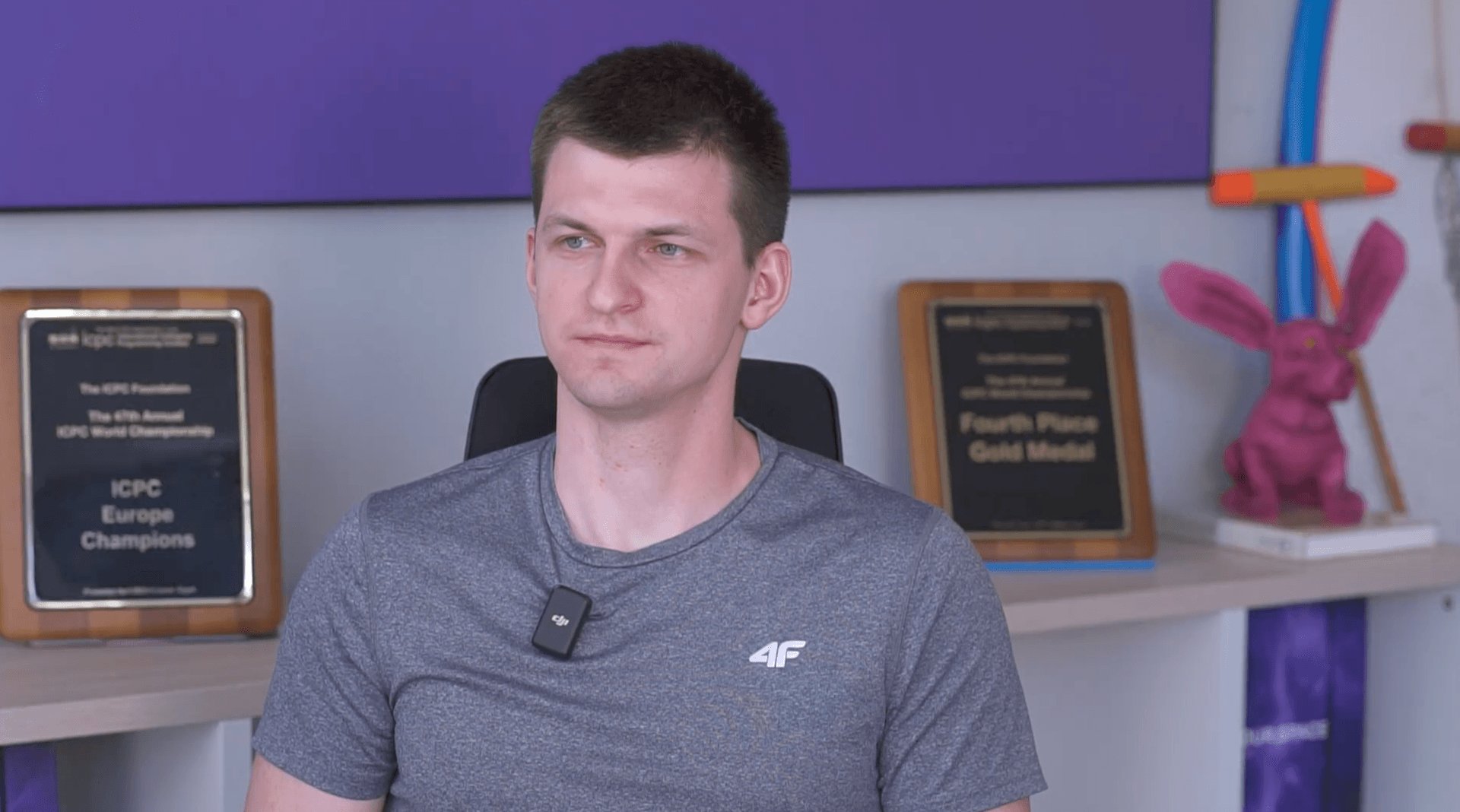
Why Kamil Debowski Teaches More Than Algorithms at Harbour.Space
At Harbour.Space, we do not look at computer science as a list of abstract topics to survive and forget after an exam. We look at it as a discipline that trains the mind to solve difficult problems with clarity, precision, and persistence. That is why faculty matter so much here. Students do not just need people who know the theory. They need people who have lived at the highest level of the craft.


Campus Academic Director
At Harbour.Space, we do not look at computer science as a list of abstract topics to survive and forget after an exam. We look at it as a discipline that trains the mind to solve difficult problems with clarity, precision, and persistence. That is why faculty matter so much here. Students do not just need people who know the theory. They need people who have lived at the highest level of the craft.
At Harbour.Space, we do not look at computer science as a list of abstract topics to survive and forget after an exam. We look at it as a discipline that trains the mind to solve difficult problems with clarity, precision, and persistence. That is why faculty matter so much here. Students do not just need people who know the theory. They need people who have lived at the highest level of the craft.
Kamil Debowski is one of those people.
Many in the programming world know him as “Errichto”. At Harbour.Space, our students know him as a teacher who brings seriousness, sharpness, and real competitive depth into the classroom. He teaches Advanced Algorithms and Data Structures, a course built around the key and in-depth algorithms and data structures that form a modern computer specialist’s toolkit. The course is intensive by design and asks students not only to understand ideas, but to implement them, test them, and use them to solve demanding problems.
This is exactly the kind of learning environment we believe in.
A Teacher With Real Algorithmic Credibility
Kamil’s background is not academic in the narrow sense. It is practical, global, and proven in the most demanding arenas of programming. He participated in mathematics contests from school age, then moved into competitive programming and reached the highest possible titles on two of the most respected platforms in the world: Codeforces “Legendary Grandmaster” and Topcoder “Target.” He has also authored more than 300 problems for platforms such as Codeforces, Topcoder, and Codechef.
His competitive record is equally strong. It includes second place in Google Code Jam 2018, finalist positions in Topcoder Open 2018 and Facebook Hacker Cup, wins in Google Kickstart, and international recognition as both competitor and coach. That range matters. It shows students that strong algorithmic thinking is not a niche classroom exercise. It is a skill that holds up under pressure, against world-class peers, over many years.
And yet what makes Kamil especially valuable to Harbour.Space is not only what he has won.
It is the fact that since 2018 he has been teaching full-time across formats: high school classes, competitive programming camps, private coaching, video lessons, commentary, and public educational content. His teaching has reached a wide audience through his YouTube channel and streams, but in our setting that reach becomes something more focused. Students get direct access to a person who has spent years not just solving hard problems, but explaining them clearly to others.
What students actually learn in Advanced Algorithms and Data Structures.
The name of the course sounds rigorous because it is.
Students work through the algorithms and data structures that sit at the heart of modern computer science problem-solving. The curriculum includes heaps and binary search trees, segment trees, persistent data structures, string algorithms such as Knuth-Morris-Pratt and Manacher’s algorithm, graph algorithms, dynamic programming, and more. The course also addresses computational complexity and comparative analysis, which is essential if students want to move from “I can code this” to “I understand why this is the right approach.”
Just as important is how the course is taught.
This is not passive theory. Students are extensively trained in implementation and problem-solving. Their programs are tested against carefully prepared test cases through an automated testing system. The structure includes lectures, assignments, classwork activity, and exams, with a strong emphasis on actually writing and refining code.
That matters because algorithms are one of those areas where false confidence is easy. A student may follow a lecture and feel they understand it. Then they sit down in front of a real problem and realise that understanding in principle is not the same as being able to execute. A good teacher closes that gap. Kamil does.
Why This Matters at Harbour.Space
At Harbour.Space, we say often that students should learn from the most knowledgeable and successful people in technology and design. That principle only means something if it shows up in the classroom in a real way. With Kamil, it does. Our students are not learning advanced algorithms from someone who only knows them from a textbook. They are learning from someone who has built a career around applying them at the highest level and teaching others to do the same.
This fits the wider educational model of Harbour.Space as well. We believe in intense, relevant, practice-oriented learning. The three-week format of the course reflects that philosophy. It is focused, demanding, and built around useful depth rather than vague coverage. Students spend 45 hours in a course that treats algorithms as a living toolkit, not as decorative theory.
For a computer science student, this kind of course changes something fundamental. It improves technical skill, of course. But it also changes how students think. They become more structured, more exact, more patient with complexity. They learn how to break down a problem, choose an approach, test assumptions, and keep going until the solution is both correct and efficient.
That is valuable far beyond contests.
It is valuable in software engineering, systems design, research, machine learning infrastructure, quantitative work, and any technical field where the difference between a decent solution and a strong one lies in the quality of thought behind it.
From Individual Excellence to Team Results
There is also a broader impact to Kamil’s work at Harbour.Space.
He has coached Harbour.Space competitive programming teams that achieved standout results, including medal-winning performances that helped place the institution among the strongest performers in Europe and at the ICPC World Finals level. In Harbour.Space coverage of those results, his role is described not only through his credentials, but through the discipline and constant practice he brought to the teams.
That is an important point. Great faculty do not simply transfer information. They shape standards. They influence how students train, how they approach difficulty, and what level of seriousness they bring to their work.
In Kamil’s case, students see what algorithmic excellence looks like up close. Not as myth, not as internet reputation, but as a teaching practice.
The Kind of Education We Want to Offer
As Academic Director, I think often about what students remember years after a course ends.
Usually it is not every theorem or every implementation detail. It is the moment when a subject becomes real. When they see what good work actually looks like. When they realise that mastery is built through repetition, feedback, and ambition, not talent alone.
Kamil Debowski brings exactly that kind of reality into the room.
Advanced Algorithms and Data Structures is not an easy course, and it should not be. It is part of the intellectual foundation of serious computer science. Taught well, it gives students far more than technical content. It gives them a stronger internal standard for how to think.
That is why Kamil belongs at Harbour.Space.
And that is why our students benefit so much from learning with him.
Thanks for reading
If you're interested in further growth, take a look at our website to learn what your future could look like at Harbour.Space. Lastly, get in touch with us at hello@harbour.space to let us know your thoughts!